
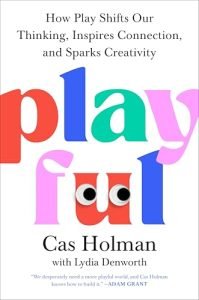
Cas Holman writes in chapter 3 of Playful that play commonly serves as a pressure release valve: a low-stakes way to let off steam, to grapple with emotions, to let go of cares and worries for a time. It helps us celebrate good times and cope with hard times. And if we can let go of our biases about which emotions are acceptable, we can be playful even when we are sad. Play gives permission to feel joy alongside the hard stuff, possibly most when we need it most.
I’ve been thinking about that a lot lately.
I reviewed Playful recently on my personal site and came away wanting more depth, but also genuinely glad it exists. Anyone making the case that adults need play is doing important work. We’ve been trained out of it. We want to know something will work before we begin. We want the pattern, the recipe, the guarantee. Play asks something different. Play says: begin anyway.
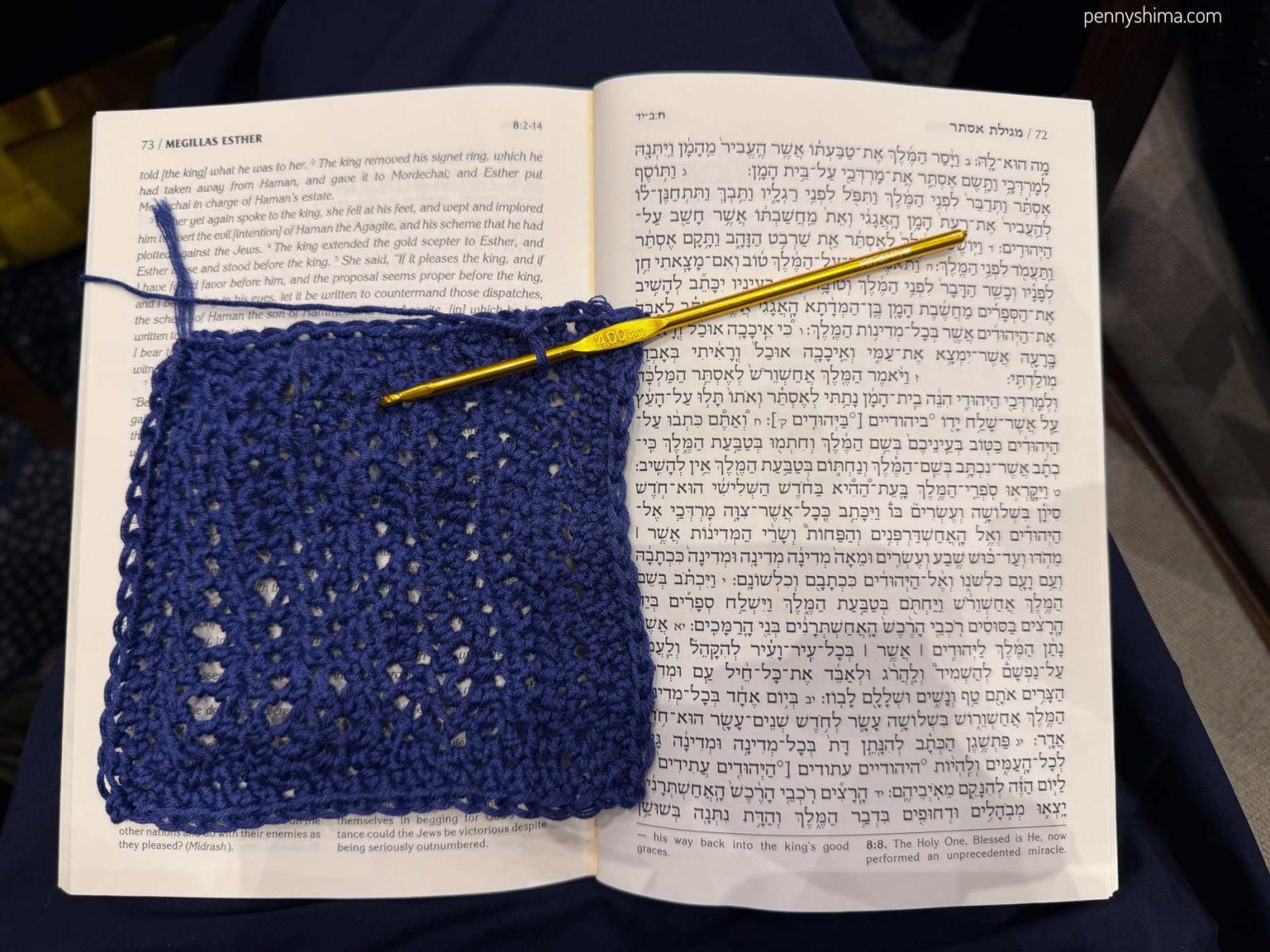
I try to build this into everything I do at little acorn creations. The swatch library project is really just play, documented. A swatch is a low-stakes place to ask what if — what if I held two strands together, what if I tried this stitch on a larger needle, what if I don’t know yet but I’m curious enough to find out. The worksheet exists so those experiments don’t disappear. Iteration, kept.
The thursday circle runs on the same energy. It’s a small, intentional group, and yes, I’m there to help troubleshoot and answer questions. But what I really want people to feel is permission. Permission to try something that might not work. Permission to rip it back. Permission to say “I’m not sure, but let’s try this to figure it out” and mean it without anxiety. That phrase might be my most-used teaching tool.
Holman also writes that play requires comfort with change, and it asks us to be brave: to put ourselves out there and trust we’ll be seen. It requires trusting ourselves and each other. I think about this a lot. Play increases contentment, helps us process uncertainty, and builds resilience. Life is hard, and the world is extra heavy right now. If we can find joy alongside that, not instead of it but along the way, that matters. That’s the thread running through my IYT project too. The way making connects us to something larger than the project in our hands. Community, presence, healing. Joy belongs in that list.
Which brings me to today. It’s Purim.
If you’re unfamiliar with it: Purim is a Jewish holiday that is essentially a mandate for joy. We celebrate by reading the book of Esther (the megillah, meaning scroll), and it’s quite a remarkable story. We give gifts of food and money, we eat, we make noise (specifically to blot out the name of the villain Haman), and there are very often costumes. The full turning-the-world-upside-down treatment. There’s even a phrase for it: ונהפוך הוא, v’nahafoch hu, and it was turned upside down. This guide sheet by The Rabbi Sacks Legacy has a good overview if you want to read more.
My shul framed it beautifully this year: costumes aren’t the extra. They’re part of the spiritual work. Silliness can be sacred. Purim has known this for a few thousand years.
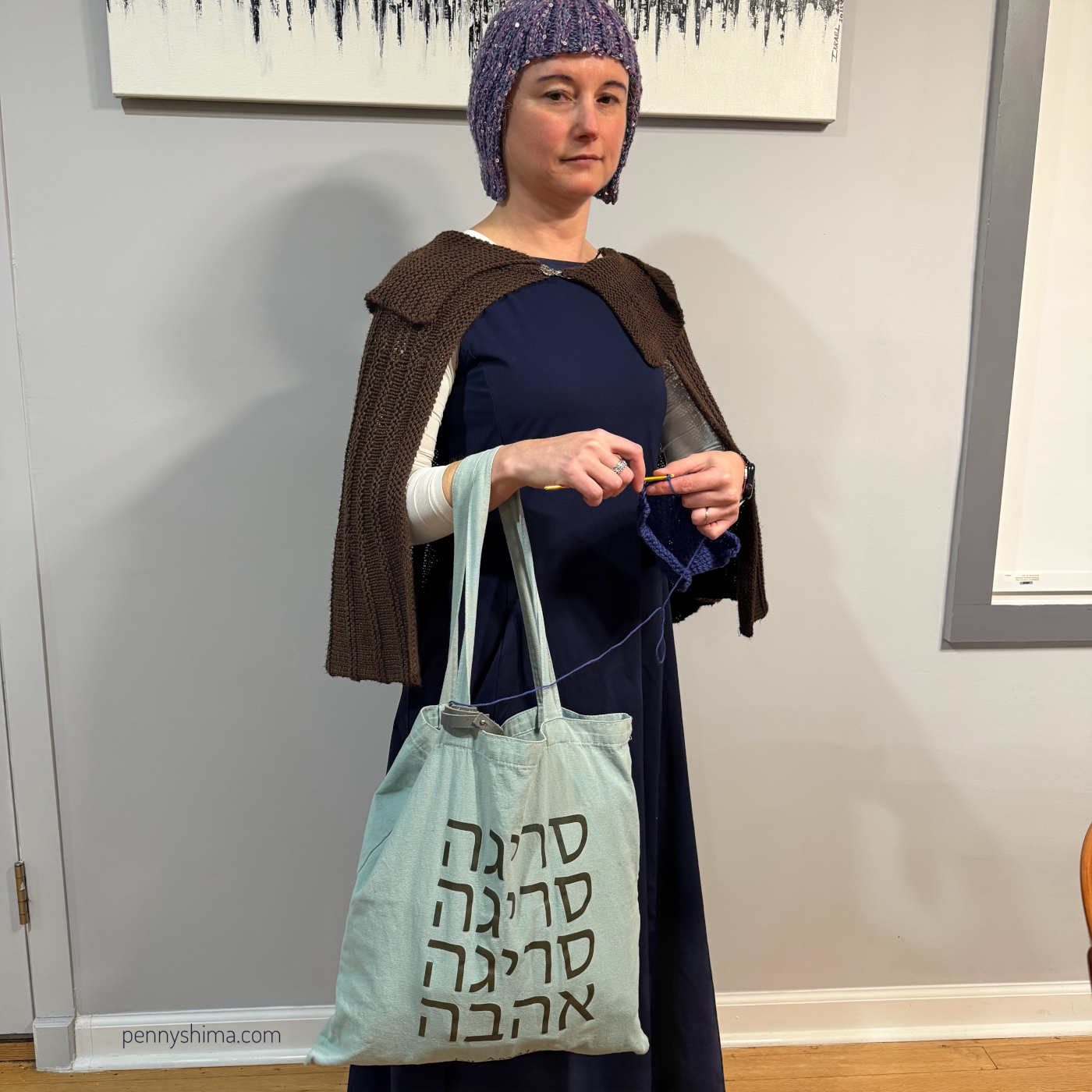
This year the theme was heroes and villains, choose a side. I am not capable of being a villain, so I committed fully to yarn hero.
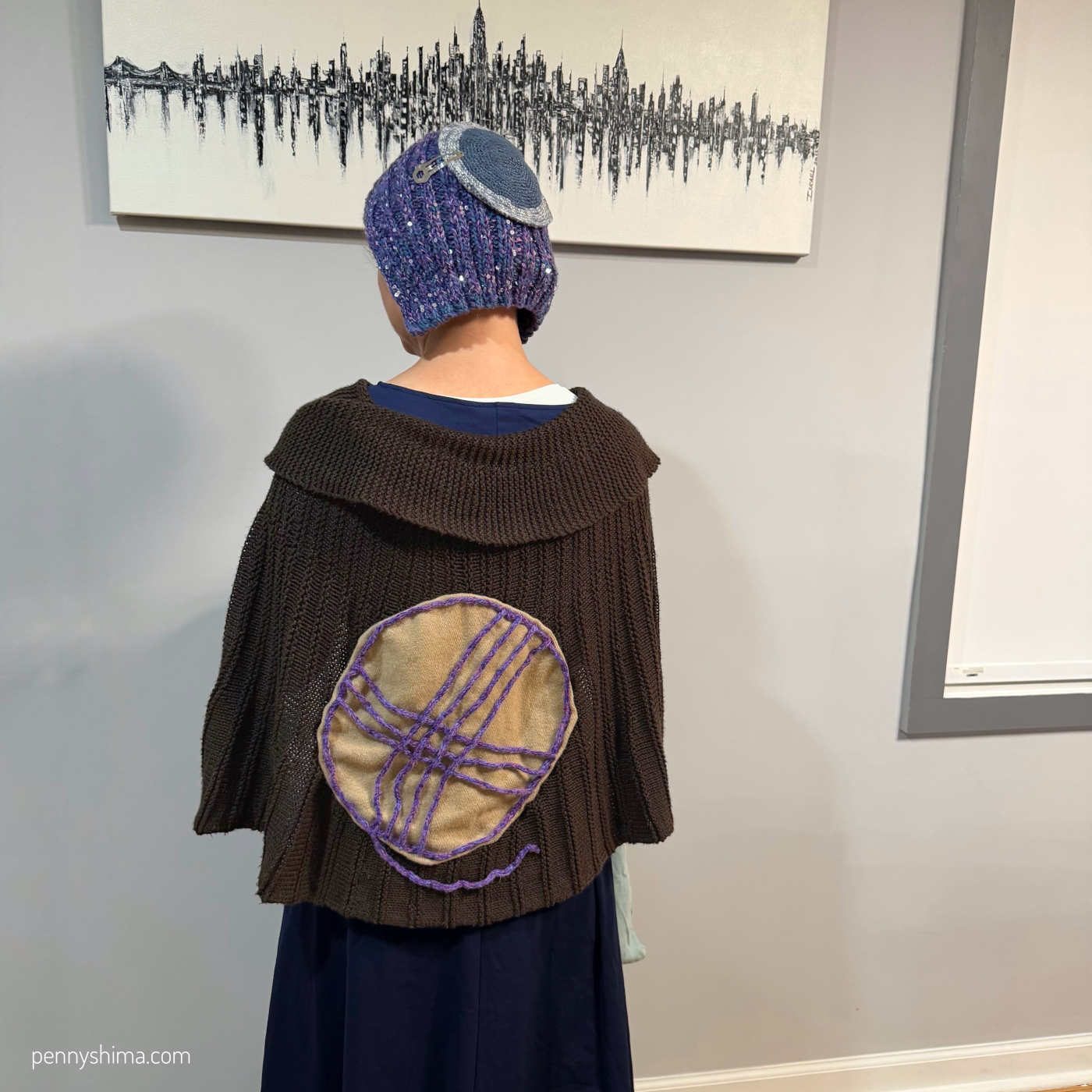
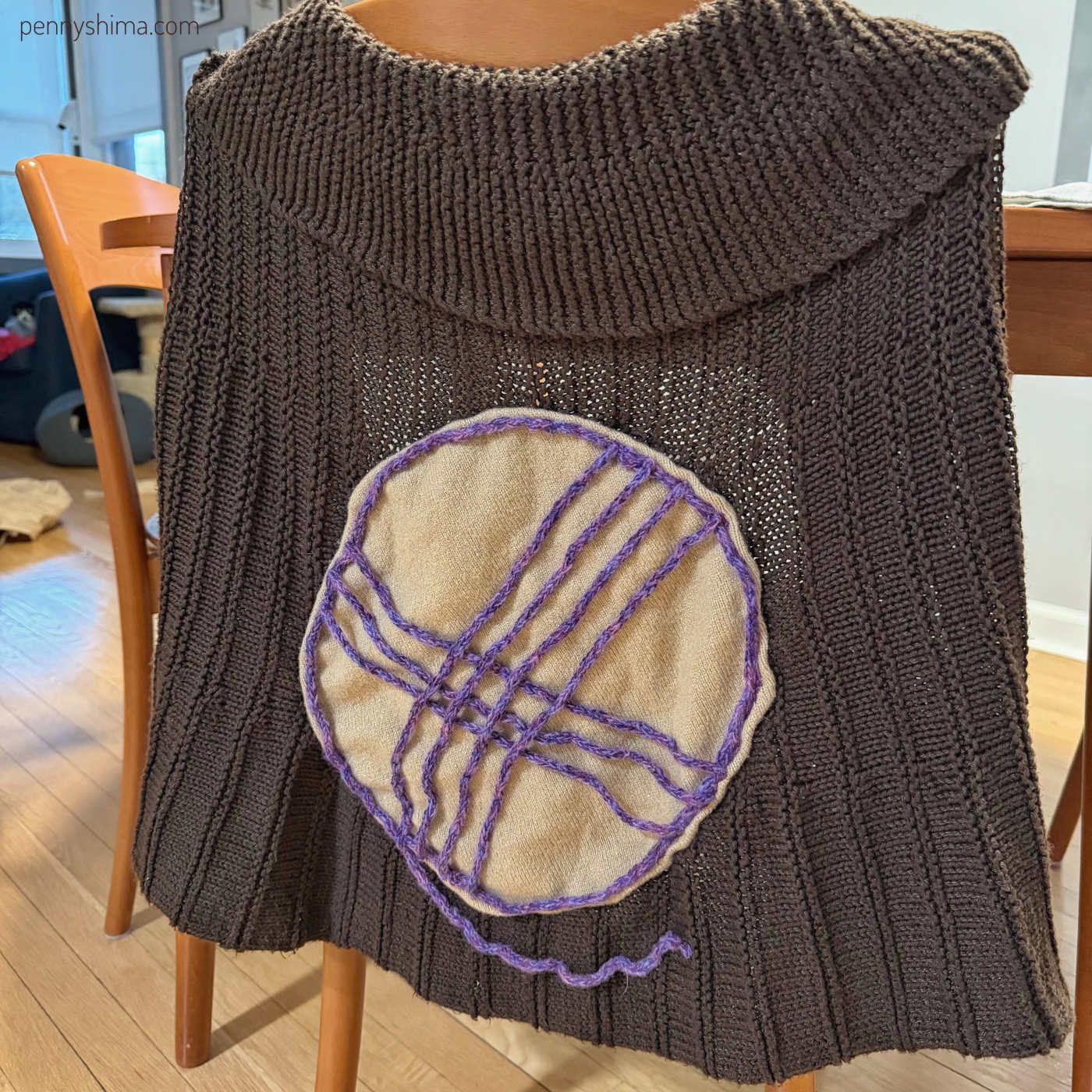
I went diving in my bins of samples, swatches, and yarns. What could I reuse? I found a brown cape I added a yarn ball logo to with lots (and lots) of i-cord. I found some nearly-white stockinette swatches I sewed together to make a knit megillah1. And I knit a wig: marled purple and teal with a little sparkle, made with yarns pulled from deep in my stash. My knitting tote bag rounded out the kit, full of yarn, hooks, needles, a tape measure. My superpower is obvious: rescuing projects from despair, mending holes, keeping heads and necks warm, liberating yarn from the stash, weaving in ends.
Even just preparing the costume has been the most fun I’ve had knitting in a while. Though the longer I sat with it, the more I thought: this is just my regular Tuesday, with better hair. The work I do every day, teaching, troubleshooting, helping people find their way through a pattern or a problem, isn’t about glory. It’s because the skills are there and the need is real and there’s something genuinely satisfying about being useful. The cape is normally invisible. Purim just gave me permission to make it sparkle.
That’s the whole invitation, honestly. Purim has joy scheduled on the calendar and makes it a mitzvah. But you don’t need a holiday to give yourself permission to make something just to see what happens. To swatch a yarn you’re curious about. To show up to the circle with a project you’re not sure about yet. To begin before you know how it ends.
Begin anyway. See what happens.
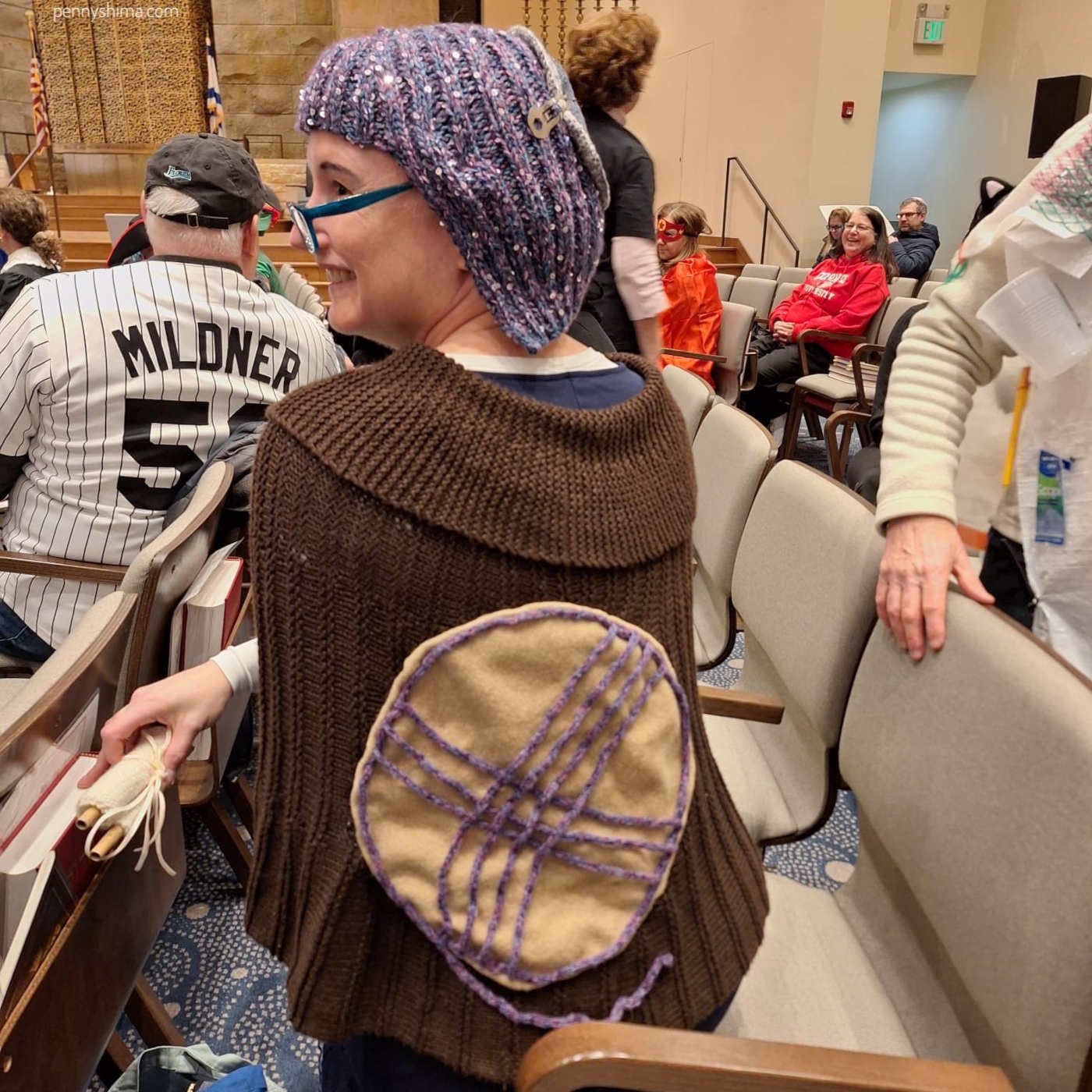
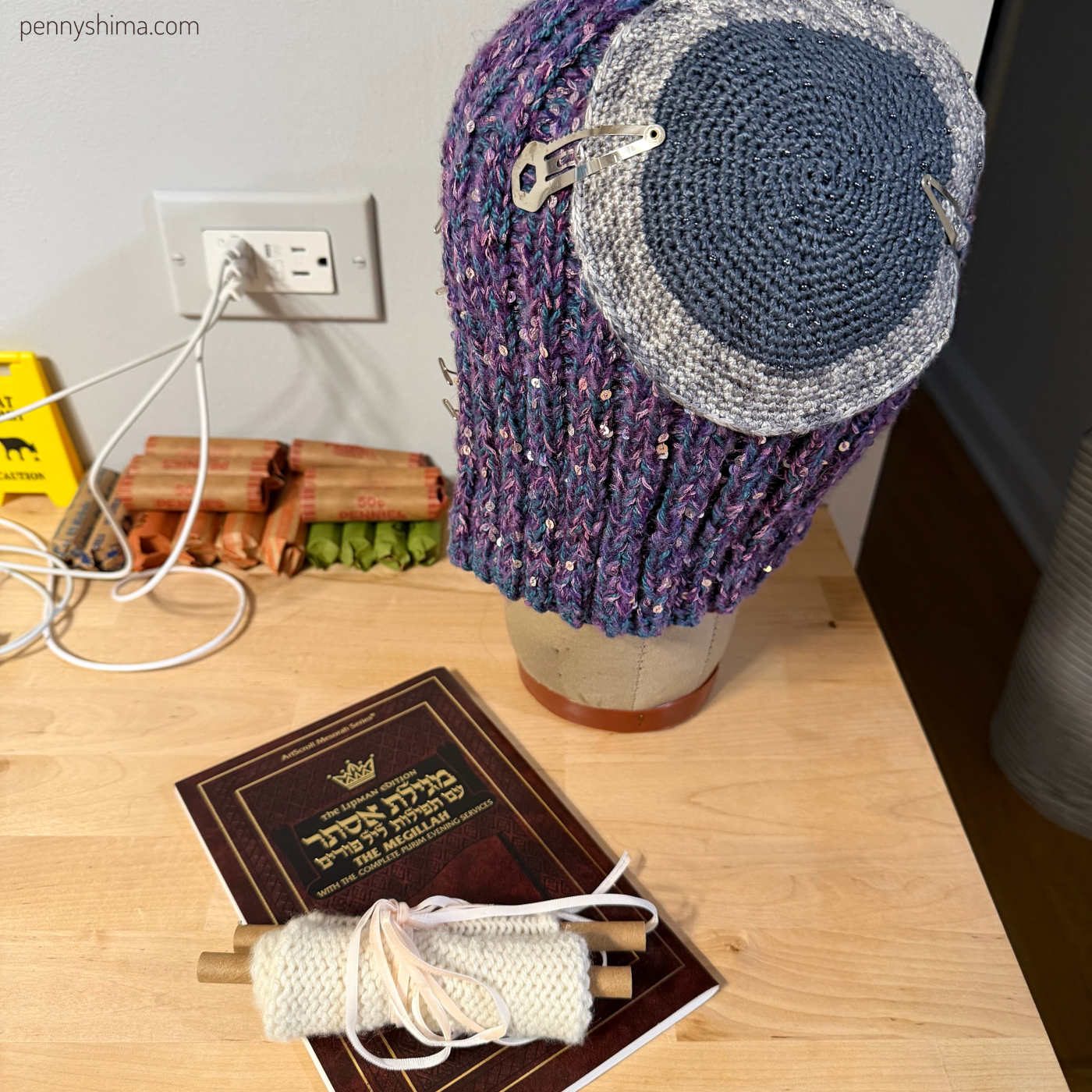
- Ok, it looks more like a Torah but I’m going to claim artistic license for this (and get double duty with it on Simchat Torah). ↩︎
Leave a Reply