
There are several topics where I’ll wax poetic: a good book, the right yarn and needle and design combination, and ergonomics.
I was an early adopter of thinking about this. At seven years old, I befriended an elderly woman with memory loss who had built her house years before, anticipating aging in place. She’d widened doors, chosen lever door knobs, and lowered light switches. It was just her house, and short seven-year-old me appreciated those lowered light switches. The mid-80s were not a time this was thought or spoken about, any of this.
About a decade later, while in all the stress of high school, I learned more. Not because I was a precocious student (though I was), but because I was playing bassoon at a high level and I’m on the petite side. That instrument is not piccolo sized (yes, I did play that too). I needed to learn how to reach some of the keys without thumb pain1. I also found myself wearing bifocals at 16 to read the mid-distance (a music stand). A good friend was faced with ending her music career or working with both physical and occupational therapists to learn ways to play her violin without pain. We spent many summer afternoons at music camp talking about it. It changed both our lives. For me, I accepted adaptations as things we do, we need, and they aren’t a big deal. She chose to focus on this, and it’s been her career; she’s an occupational therapist. While we’ve lost touch, I think of her often and how encounters shape us in ways we never expect.
Fast forward to college and Computer Science. Hours at a keyboard led me to discover a Kinesis ergonomic keyboard. My first one lasted about 20 years; my new Advantage 360 is just over a year old, and I’m thrilled to still type pain free. Adaptations became my normal, from wooden spoons to reach kitchen shelves to specialized equipment that lets me do what I love without pain.
Enter Carsen Demers
One of my most favorite resources to pull out when I work with new students isn’t the technique book or stitch dictionary they expect. It’s Carsen Demers’ Knitting Comfortably: The Ergonomics of Handknitting. It’s the sort of book that makes me wish for a time machine so I could give it to my younger self. Why? Then I may have developed better habits and not have to think so actively about how I move my body today.
First and foremost: If you are experiencing pain, get thee to a doctor for a proper evaluation. Neither the book nor this post constitute medical advice. Both are for informational and educational purposes. I (and the author) disclaim any liabilities for injury and damages caused by reading the book. (CYA, as they say.)
What’s Inside
This title comprises 13 chapters covering basically everything: from explaining ergonomic basics and how your body moves, to what happens when you knit, to how to think about knitting ergonomics and ways to both intervene early and provide self care. This is a massive volume (that you should read carefully; it’s heavy and physically a large book).
The information is explained in a way where you don’t need to remember biology class or draw human anatomy from memory. The pictures and illustrations are clear, and there are lots of charts to help you pinpoint what you need to know. Demers breaks down how different sitting positions affect your spine, how hand positions create tension in your forearms, and what happens in your shoulders when you hunch over your work. It’s fascinating in a “oh no, I do that” kind of way.
Chapter 9, which covers tools and materials, is one I turn to often. I most definitely appreciate his chart on needle characteristics, explaining different materials, how flexible and heavy they are, and what friction they might provide with certain yarn. Many of the knitters I work with on our sisterhood project love long straight aluminum knitting needles and what I’ll call the crochet hooks we all grew up with. There’s nothing wrong with them, but they can hasten overuse pain. Understanding why (weight distribution, grip diameter, material friction) helps us make better choices.
Putting It Into Practice
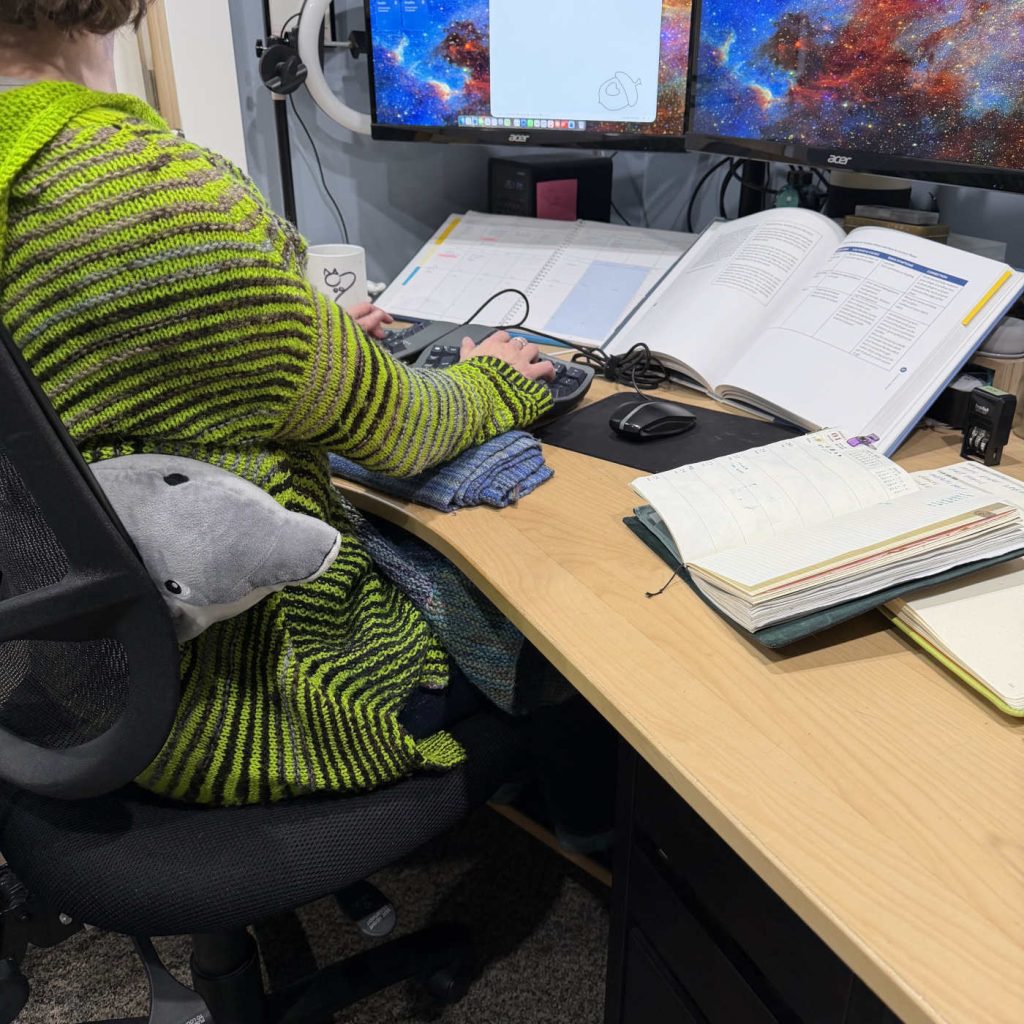
I find myself turning to this book when I’m told by someone that they have pain when working. I ask how and where they sit as they knit or crochet. Often they’re in a comfy chair and hunched over with poor posture and lighting. I suggest pillows (or stuffed animals) for support, and I’m a fan of task lighting. There are many options at Amazon today; your mileage may vary on quality, so if you have questions I’ll try to help you out.
Honestly, looking at the cover when I was drafting this review had me both adjust my footstool (my legs are short and my feet don’t touch the floor, so I have footstools at my desk and work couch) and add a stuffed animal behind my desk chair to shorten the depth of the chair until I take the time to adjust it properly. The book works on you even when you’re just thinking about it.
Right now I have a knitter who experiences pain when purling. She’s not into learning a new method, so she goes for her regular acupuncture and rests after every few rows. I keep flipping through the book to find new ideas to help. It’s slow going, but that’s how adaptations work. They’re personal, and they take time.
Who This Book Is For
This book is for everyone who uses their hands for fiber arts. Whether you’re:
- A newer knitter or crocheter who wants to build good habits from the start
- An experienced maker dealing with new or worsening pain (hello, mid-40s body changes)
- A teacher working with students of any age, but especially older adults where arthritis is a given
- Someone who thinks “I’ll deal with it later” (spoiler: later is now, and this book helps)
Many of my knitters and crocheters are in their late 70s and early 80s. I’ve been working with them on ways they can sit more comfortably to work and maybe even adapt how they hold needles and hooks. Materials matter. Position matters. Rest matters.
Small Changes, Big Impact
What I appreciate most is that Demers holds a similar philosophy to me: change doesn’t happen overnight, and ergonomics are about making things more comfortable for you. There’s no one right way; there’s the way that works for your body, your space, and your practice.
If you’d like to learn more about implementing small changes, I urge you to read Chapter 13, Taking the Next Step, and also check out my PSG Studio post, Building Your Foundation: How Small Changes Compound.
Just like I learned with my bassoon, my kinesis keyboard, and my wooden-spoon kitchen adaptations, fiber arts are meant to be sustainable practices. Not just environmentally sustainable, but physically sustainable for our bodies. We want to keep making for years to come. Knitting Comfortably is a gift to that future self who’s still sitting with yarn in hand, pain free and full of joy.
While I have read it cover to cover a few times, these days I’m more likely to pull it off my shelf to respond to a specific query. It’s become one of those books that often finds itself on my desk instead of the shelf.
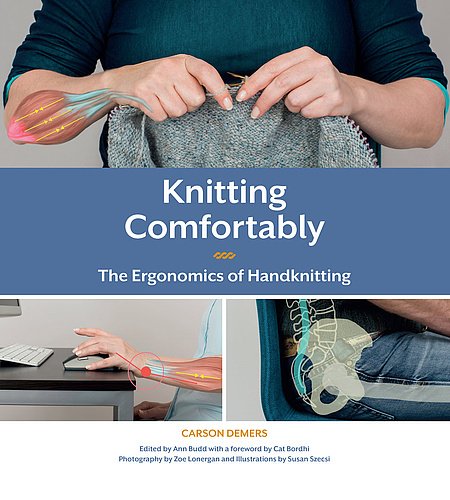
Knitting Comfortably: The Ergonomics of Handknitting
by Carsen Demers
(c) 2016. Ergo I Publishing
Available for purchase from the author at ergoiknit.com
search worldcat.org
- Later in college, my repair tech helped lengthen a key so it wasn’t a stretch. That subtle change made a world of difference. ↩︎
Leave a Reply